The Mood
Topography
?demo=1). Drop the parameter for the public view.
Select any station to reveal the journeys that passed through it.
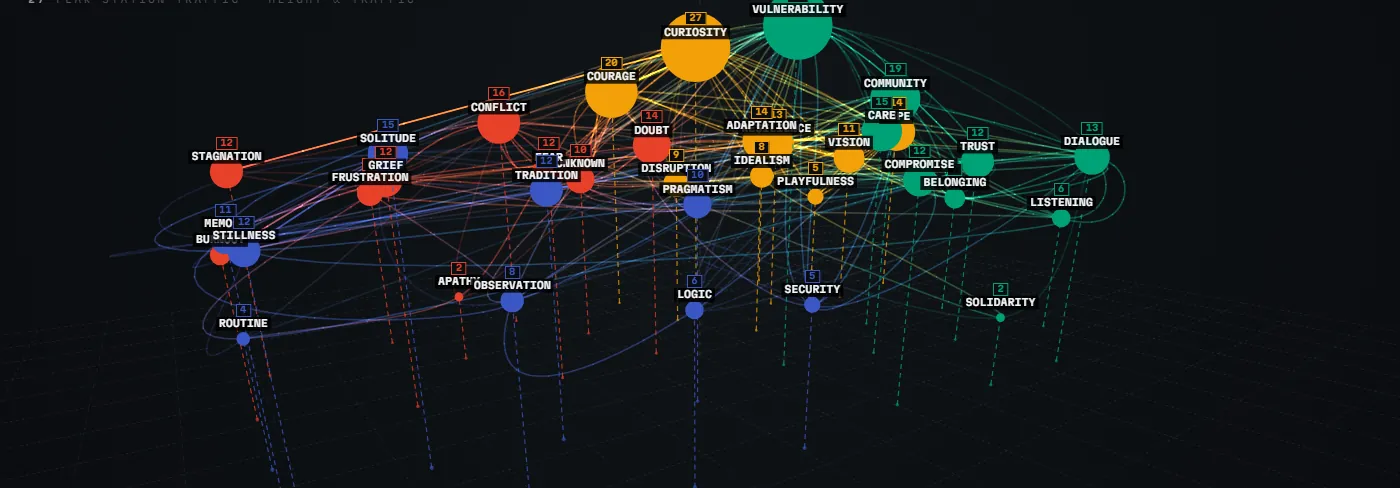 Explore the map in 3D
See the emotional landscape from another perspective. Rotate, zoom,
and explore the connections in three dimensions.
Open 3D visualization ↗
Opens in a new tab · Best experienced on desktop
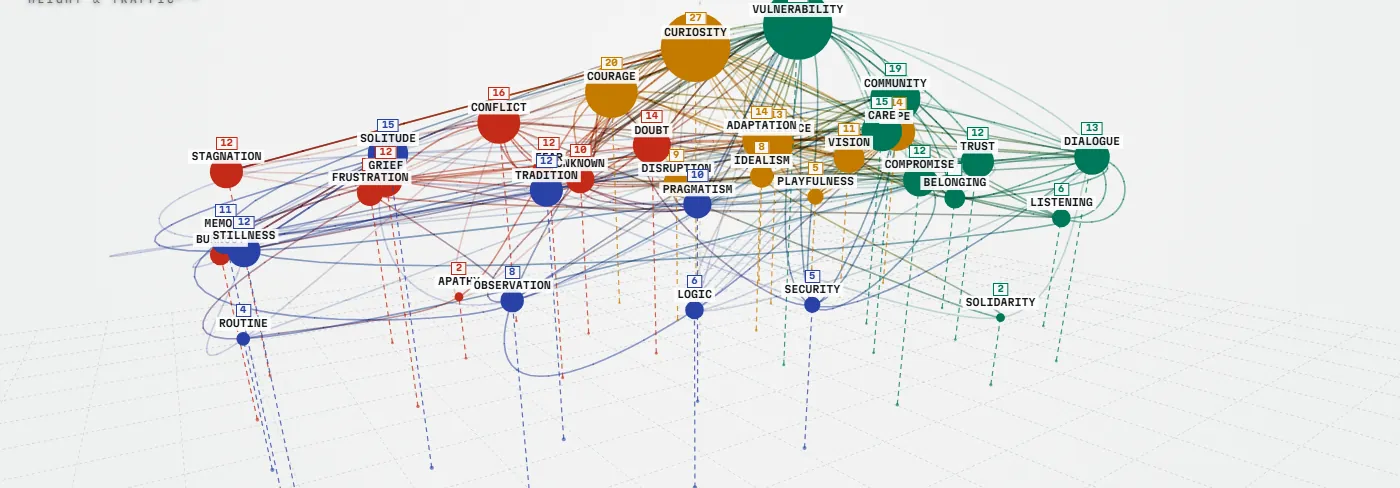
Explore the map in 3D
See the emotional landscape from another perspective. Rotate, zoom,
and explore the connections in three dimensions.
Open 3D visualization ↗
Opens in a new tab · Best experienced on desktop
What the map found
The same readings the wall spoke through the night, drawn from the finished set. Drag to browse.
Every journey
Find a station, a route, or your own path.
The night in numbers
Tap a station to filter the journeys above to the ones that crossed it.
Station traffic journeys crossing · tap to filter
Where journeys ended by mood category
Never used
How it worked
The piece, the interaction, and what the map is made of.
The field
Thirty-six emotional states, grouped into four mood categories — Friction & Resistance, Foundations & Reflection, Connection & Empathy, and Momentum & Vision. The layout is a transit map: related states sit near each other, and each category holds its own region of the field.
The interaction
Each visitor was asked one question: what path brought you to now? They anchored the station where this chapter of their life began, then traced the ground they crossed to get here, ending exactly where they stand today. Three stops minimum, ten at most. There were no right answers and no shared route, and everyone left with their own path as a keepsake.
The collective map
Every path joined a public projection the moment it was cast — the wall announced each arrival before drawing it, so the person who cast it could watch their own route appear — and it wrote out what it found in the accumulating map — the heaviest link, the busiest interchange, the station nobody went near. No single journey says much. Laid over each other, they start to describe a civic mood: what people find hard, what they hold onto, and the ground a room has crossed to arrive where it is.